
Resources
RESOURCES
Psychoeducational Articles
Befriending Anxiety
“One is a great deal less anxious if one feels perfectly free to be anxious"— Alan Watts
The Biodome Experiment
“One is a great deal less anxious if one feels perfectly free to be anxious"— Alan Watts
The Biodome Experiment
A scientist once wondered what would happen if we could live in a perfect environment. So they built a huge glass dome in the desert, ideal for life, with purified air and water, just the right amount of sunlight, fertile soil - everything a human and plant would need to thrive. For months at a time people lived inside the biodome. It seemed to be going great until, after the trees reached a certain height, they inexplicably fell over. The scientists discovered the trees needed strong wind in order for the heart wood to become sturdy and the root system to grow deep enough to support a healthy tree. The experiment was concluded early.
Changing Your Relationship with Anxiety
Chronic stress, anxiety, burnout - these have been buzzwords the past couple years and much of the advice out there focuses on how to get rid of them. Personally, I remember the last few years of grad school and starting a counseling career on top of the rest of my full life felt like a hurricane, and at that time, I would have liked nothing more than to go find the biodome and move in. (The dome’s got to still be out there somewhere; if anyone stumbles across it please send the coordinates). I tried avoiding, resisting, escaping, distracting, procrastinating - these didn't work for long, and often made things worse. And so I was down to the last resort, this counter intuitive, radical approach of not trying to make it go away - befriending the anxiety. Dennis Merritt Jones said it beautifully, “Watch how a tree bends and sways gracefully when the wind blows against it. It does not stand rigid, resisting the flow of energy. It does not push back. The tree accepts the strong wind as a blessing that helps it grow.”
The truth is that stress itself isn’t harmful - it’s the belief that stress is bad for you. One study found that people had a 43% increased risk of dying if they experienced a lot of stress and believed it was harmful, but those who reported having stress, but not viewing it as harmful were the least likely to die. The increased risk of death was not from the stress, but the belief that it was bad (Keller et al., 2012). Let that sink in. (And now are you stressed about your opinion of stress?) And that’s the tricky part - How can a person change their perception that an uncomfortable nervousness and racing heart and mind is a good - or at least neutral - thing?
Approaching Anxiety with Non-Judgmental Mindfulness
Fear is a natural and useful human emotion, yet we are socialized to feel flawed and weak if we experience it. We criticize ourselves when we feel fear and anxiety, and it’s the criticism, not the fear, that hurts us. In the thick of grad school, I remember walking through the grocery store, and noticed my heart racing as my mind ruminated on my long list of the undone. But it wasn't the increased heart rate that bothered me (my heart beats fast when I’m out for a run, dancing with abandon, or when my husband smiles at me), it was my self judgements about my heart rate that was the problem, “What’s wrong with me? I shouldn’t be like this, I'm a therapist! I don’t want to feel this way.” When I became mindful of the physical sensations of anxiety without judgment, I could welcome them, become curious about what was happening in my body and mind and accept my experience as part of a full life. Try experimenting with words or phrases like, “Welcome. Yes. This belongs. May I accept all my experience. And.” The word “And” reminds me that I can do what I value and feel anxiety. Sometimes we have to be willing to feel discomfort if it means moving toward a future that we want. One of the tolls of anxiety is that it keeps us from living a full life as we try to avoid those situations that provoke it. Example: It took me months to write this post! I was avoiding writing one because, what if it was bad? (I was too anxious to write a blog post about anxiety. Ah, the irony). I was thinking, "I want to do it but, I'm too stressed." However, I value spreading this knowledge more than feeling comfortable all the time, so I breathed acceptance and compassion into my discomfort and told myself, “I want to write a blog post and I’m stressed about it." And here we are. A strong body of evidence supports meditation for reducing stress and anxiety (Goyal et al., 2014)...which is a bummer because I’m accepting my anxiety now and don’t mind if it hangs around or whatever. But here’s a meditation anyway by Dr. Jared Warren for accepting stressful emotions. I love this one and listen to it often:
https://www.youtube.com/watch?v=goC-SGbFD_E
And here's a great book on meeting anxiety with mindfulness. (Again, not to make you go away, Anxiety. Feel free to put your feet up, we’re BFF’s now). To reduce that extra layer of my resistance toward my guest:
The Mindful Way Through Anxiety, by Susan Orsillo and Lizabeth Roemer
And if you would like professional help dealing with anxiety, come see me at Andrea Hunsaker Counseling.
May we gracefully bend with the wild wind of our stress and grow to consider it a friend.
Be Well,
Andrea Hunsaker, LPC, NCC
References
Keller, A., Litzelman, K., Wisk, L. E., Maddox, T., Cheng, E. R., Creswell, P. D., & Witt, W. P. (2012). Does the perception that stress affects health matter? The association with health and mortality. Health psychology : official journal of the Division of Health Psychology, American Psychological Association, 31(5), 677–684. https://doi.org/10.1037/a0026743
Goyal M, Singh S, Sibinga EMS, et al (2014). Meditation Programs for Psychological Stress and Well-being: A Systematic Review and Meta-analysis. JAMA Intern Med.174(3):357–368. doi:10.1001/jamainternmed.2013.13018
March 20, 2022
Goyal M, Singh S, Sibinga EMS, et al (2014). Meditation Programs for Psychological Stress and Well-being: A Systematic Review and Meta-analysis. JAMA Intern Med.174(3):357–368. doi:10.1001/jamainternmed.2013.13018
March 20, 2022


Communication: Hear Me, See Me, Feel Me
Nov, 2024
by Andrea Hunsaker
Three young monkeys lived in the jungle. After counseling with a wise old teacher, one committed to hear no evil, one to see no evil and one to speak no evil. The monkeys set out on their noble endeavor, but soon became disheartened because their jungle friends didn’t want to be around them anymore and the monkeys were sad and lonely. So, they returned to the wise one for help. “Tell me more about how you are protecting yourself and others from evil,” the wise one asked. The monkeys proudly explained that the one who heard no evil would cover his ears whenever another said something he thought was wrong. The one who saw no evil would close his eyes to others’ perspectives when they clashed with his sense of goodness. And the one who spoke no evil closed his heart and met others with silence in conflict so nothing bad would enter or escape him. “Ah,” said the wise one, “I see. You mistake evil for difference.”
Albert Einstein remarked that the most important decision a person will make is to decide whether or not the universe is a friendly place (Julie, 2023). That decision has to be made with every interaction. It sure doesn’t feel very friendly when your text is ignored, you’re criticized, or your partner uses that ‘tone’. But in our personal interactions, if we can trust in others’ overall basic goodness, we can see through their seemingly harsh actions and defenses, and can more easily lay down our defenses and be open, unguarded and connected. As a counselor for couples, the first thing I do is teach some communication ground rules. I once made the mistake of letting it slide, and in that session the conflict became so heated, their voices were heard outside the building and one partner walked out and slammed the door. So, here’s some free therapeutic advice that I wish all the world knew and practiced.
A Metaphor for Playing Catch
Connection. Intimacy. Feeling seen, heard and safe with another person- It all starts with communication, and communicating can be compared to a game of catch. I throw a ball to you, you catch it, you throw a ball back. We’re sending messages back and forth. These messages are pieces of us. It takes trust and vulnerability. It’s no fun when you toss a ball to me and I’m picking dandelions, or we’re both throwing balls at the same time and no one is catching anything, or I nail you with a fast ball in the face. It takes practice in both sending a ball that is easily catchable and in receiving the wild throws, but getting a little better at these skills can really make a difference in the quality and intimacy of your relationships. Here are some ground rules from the Speaker/Listener Technique (Stanley et al., 1997), and the Imago Couples Dialogue (Hendrix & Hunt, 2019).
Rules for the Listener
Switch roles until both feel heard and understood. But what if you are the only one trying to use these skills? It still makes a difference. A relationship is like a dance. If you change your steps from the waltz to the foxtrot, the other person will likely change theirs too. Hearing, seeing and feeling into another's world opens up their goodness to you, and they are no longer someone to fight or fear. The universe is a safer place. Remember the quarreling couple? After some time to cool down, the client came back into the room, I taught these skills, and the flavor of the interaction was strikingly improved. Voices were calmer. They paused and took in before responding. They looked into each other’s faces. They softened. It took courage for them to speak from their vulnerable places and really try to understand at a deeper level, but the payoff was worth it. All along they just wanted their goodness to be heard, seen and felt.
“I don’t like that man. I must get to know him better".— Abraham Lincoln
Rules for the Speaker
- Present your concern with a soft delivery without blaming the other or judging their character. Give your thoughts as a gift to the listener to see inside a vulnerable place inside you - A gift of intimacy (in-to-me-see).
- Ask for time.
- Use “I” messages. Focus on what you’re feeling and what you need, not on accusing the other person. Own your emotions. And if you are feeling angry, search underneath the anger for hurt or fear and be willing to express that.
- Use small chunks at a time, don’t overwhelm the listener.
- Stay on topic. (Stanley et al., 1997).
Rules for the Listener
Listen to understand, not to rebut. Hold your reactions for later. (Holding back rebuttals might be the hardest part of it all. Breathe. Send yourself lots of compassion.)
- Hear Me - Paraphrase in your own way the content of what you heard. This might seem like an unnecessary thing, but when you are with a person who does this well you feel so valued. They have really listened to you and registered what you were trying to say. “What I hear you saying is___. Is that right?”
- See Me - Validate what the speaker has said by putting yourself in their shoes and trying to see things from their perspective. This is not admitting that they are right and you are wrong, this is simply acknowledging that from their view of the world, they have a point as well.
- Feel Me - Show empathy for the speaker's emotions. Really imagine how being in their position would feel. Name the specific emotions that you think they are experiencing.
Switch roles until both feel heard and understood. But what if you are the only one trying to use these skills? It still makes a difference. A relationship is like a dance. If you change your steps from the waltz to the foxtrot, the other person will likely change theirs too. Hearing, seeing and feeling into another's world opens up their goodness to you, and they are no longer someone to fight or fear. The universe is a safer place. Remember the quarreling couple? After some time to cool down, the client came back into the room, I taught these skills, and the flavor of the interaction was strikingly improved. Voices were calmer. They paused and took in before responding. They looked into each other’s faces. They softened. It took courage for them to speak from their vulnerable places and really try to understand at a deeper level, but the payoff was worth it. All along they just wanted their goodness to be heard, seen and felt.
“I don’t like that man. I must get to know him better".— Abraham Lincoln
Be Well,
Andrea
References
References
Hendrix, H., & Hunt, H. (2019). Getting the love you want: A guide for couples: Fully updated and revised. Macmillan Audio.
Julie. (2023, February 27). “Do you live in a friendly universe?” redux - julia B. colwell, ph.D.. Julia B. Colwell, Ph.D. - Personal Transformation through Relationship. https://juliacolwell.com/archives/1926
Stanley, S. M., Markman, H. J., Blumberg, S. L., & Eckstein, D. (1997). The speaker/listener technique. The Family Journal, 5(1), 82–83. https://doi.org/10.1177/1066480797051013

Gut Health and Well-Being Connection: Is Your Diet a Downer?
July 5, 2023
by Andrea Hunsaker
"Good food is the foundation of genuine happiness."— Auguste Escoffier
by Andrea Hunsaker
"Good food is the foundation of genuine happiness."— Auguste Escoffier
We all have our coping strategies in times of stress. During the pandemic one of mine was that seducing siren tonic—sugar, in all its forms. Normally, sans outbreak, I am a respectably healthy eater who takes secret pleasure in the sound of my family’s complaints when I serve quinoa and kale, but those habits can slip under pressure. One large survey from a COVID-19 symptom study found an increase in snacking and an average gain of 7 pounds during the lockdown. So, we coped by eating junk food because we were a bit—or a lot—anxious and depressed. …Or, was it also the other way around? What if the junk food contributed to our blues?
I’ve always suspected my stomach had a mind of its own, but recent research on the gut-brain connection brings our understanding of the power of our bellies over our mental health to a profound new level. The gut has been named the “second brain” because it contains 100 million neurons which communicate with the brain in our head through the vagus nerve and produces many of the same neurotransmitters (like serotonin, dopamine, and GABA), all of which play important roles in mood regulation. In fact, it is estimated that the bacteria in the gut produce 95% of the body's supply of serotonin. It is now thought that trouble in the microbiome of the gut may contribute to an array of diseases such as depression, anxiety, memory loss, hypertension, obesity, and type 2 diabetes. People with chronic GI disorders such as Crohn's disease, ulcerative colitis, and irritable bowel syndrome (IBS) have much higher than normal odds of also suffering from anxiety and depression.
Dr. Leslie Korn, an expert in mental health nutrition, and author of Eat Right, Feel Right declares, “There is no doubt that nutrition affects mental health. Poor nutrition leads to and exacerbates mental illness. Optimal nutrition prevents and treats mental illness.” Observational studies support her assertion; for example, one study found that adhering to a traditional Mediterranean and anti-inflammatory diet offers some protection against depression (Lassale et al., 2019). Additionally, studies where participants ate more fruits and vegetables reported increased life satisfaction, happiness, vitality, flourishing, and well-being (Blanchflower et al., 2013; Conner et al., 2017). This is great news, because this is something we can control. Along with exercise, gratitude, and the other positive psychology strategies, nutrition is a strategy fully within our power to lead to a better life. Korn refers to the digestive system as a garden that requires a variety of the right amounts of different elements for proper function. Here are some of her suggestions:
Eat More…
Eat Less…
With the knowledge of just how much food affects mood, I now have a new weapon in my “fueling the family” arsenal. The other night when attempting to serve sardines, I promised, “It will protect you against depression!” To which my teenager responded, “If you make me eat that, I will be depressed.” Resistant teenagers aside, Korn acknowledges that making long-lasting dietary changes doesn’t come easy. She suggests finding substitutes for the things you love - like switching out some white sugar with honey or stevia, or a traditional hot dog for an organic replacement. You might try an experiment for a few weeks and notice what happens. A review of our module on personal growth and achieving goals might also help to convert the resistant teenager within. As for me, I’ll deliberate a little longer before my next donut.
Eat More…
- Soluble fiber (oat bran, nuts, beans, lentils, peas, chia seeds, barley, and some fruits and vegetables) and insoluble fiber (wheat bran, corn, whole grains, oat bran, seeds, nuts, brown rice, axseed, and the skins of many fruits and vegetables). Fiber increases the feeling of fullness, slows down the absorption of glucose, and absorbs water like a sponge to help push materials through the digestive tract. The Standard American Diet (which makes us SAD) is notoriously low in fiber. Women should aim for 25 and men 36 grams of fiber per day. Korn refers to fiber as the ‘soil’ for the microbiome garden which allows healthy bacteria to grow.
- Prebiotics (onions, garlic, Jerusalem artichokes, leeks, asparagus, wheat, beans, bananas, agave, dandelion, chicory root, and chia). These support the good bacteria that live in the colon.
- Probiotics or fermented foods (sauerkraut, kefer, kombucha, kimchi, miso, microalgaes, brewer’s yeast, yogurt and cheeses with live cultures, and probiotic supplements). There are 400-500 different kinds of beneficial live microorganisms that inhabit the intestines and are responsible for transforming food particles into chemical messengers that support our emotional and cognitive life.
- Anti-inflammatory foods (berries, fatty fish, broccoli, avocados, green tea, peppers, mushrooms, grapes, turmeric, extra virgin olive oil, dark chocolate and cocoa, cherries, and tomatoes). These foods are the colors of the rainbow and support mental health.
- Natural saturated fats (butter, coconut, tallow, and animal fats) polyunsaturated fats (soybean oil, corn oil, sunflower oil, nuts, seeds, leafy greens, and fatty fish such as salmon, tuna, herring, mackerel, and sardines), and monounsaturated fats (avocado, olives, olive oil, and tree nuts) all support brain health.
Eat Less…
- Sugar and refined carbohydrates (desserts, soda, energy drinks, white bread, pasta, white rice, crackers, flour tortillas, and biscuits). These foods cause unhealthful, inflammation-boosting changes to gut bacteria. Inflammation has been observed to contribute to the development of a wide range of psychiatric conditions (Pariante, 2018).
- Trans fats (commercially processed foods, crackers, chips, salad dressings, shortening, partially hydrogenated vegetable oil, margarine). Even limited amounts of trans fats have been found to disrupt the body’s ability to use essential omega-3 and omega-6 fatty acids, which are necessary for brain health and as a protection against mental illness.
- Processed meats (bacon, beef jerky, salami, hot dogs). Chemicals used to cure these meats (nitrates) have been connected to psychiatric disorders (Khambadkone et al., 2020).
With the knowledge of just how much food affects mood, I now have a new weapon in my “fueling the family” arsenal. The other night when attempting to serve sardines, I promised, “It will protect you against depression!” To which my teenager responded, “If you make me eat that, I will be depressed.” Resistant teenagers aside, Korn acknowledges that making long-lasting dietary changes doesn’t come easy. She suggests finding substitutes for the things you love - like switching out some white sugar with honey or stevia, or a traditional hot dog for an organic replacement. You might try an experiment for a few weeks and notice what happens. A review of our module on personal growth and achieving goals might also help to convert the resistant teenager within. As for me, I’ll deliberate a little longer before my next donut.
“I guarantee you, if you improve your food, you will improve your mental health.— Leslie Korn, PhD
Call it a gut feeling, but I suspect she’s right.
For a deeper dive into this subject, try these sources:
https://www.healthline.com/health/best-diets-for-mental-health
https://www.researchgate.net/publication/312158346_The_Second_Brain_Trust_your_Gut
https://psychscenehub.com/psychinsights/the-simplified-guide-to-the-gut-brain-axis/
References
Blanchflower, D., Oswald, A., & Stewart-Brown, S. (2013). Is psychological well-being linked to the consumption of fruit and vegetables? Social Indicators Research, 114(3), 785–801.
Conner, T. S., Brookie, K. L., Carr, A. C., Mainvil, L. A., & Vissers, M. C. (2017). Let them eat fruit! The effect of fruit and vegetable consumption on psychological well-being in young adults: A randomized controlled trial. PLoS One, 12(2).
Lassale, C., Batty, G. D., Baghdadli, A., Jacka, F., Sánchez-Villegas, A., Kivimäki, M., & Akbaraly, T. (2019). Healthy dietary indices and risk of depressive outcomes: A systematic review and meta-analysis of observational studies. Molecular Psychiatry, 24(7), 965–986.
Pariante, C. (2018). Why are depressed patients inflamed? A new path to personalized treatment in psychiatry, Psychiatric Times, 35(5).
Khambadkone, S. G., Cordner, Z. A., Dickerson, F., Severance, E. G., Prandovszky, E., Pletnikov, M., ... & Yolken, R. H. (2020). Nitrated meat products are associated with mania in humans and altered behavior and brain gene expression in rats. Molecular psychiatry, 25(3), 560-571.

A Different Approach to Anger
Nov 21, 2023
by Andrea Hunsaker
I imagine it was surprising for my mom to open the front door and see a police officer. I imagine it was even more surprising for her to learn that the criminal he was looking for was my seven-year-old sister, who was (allegedly) involved in an incident on the walk home from school and (allegedly) punched her little boyfriend. The serious-faced officer sat my angel-faced sister down and gave her a good talking to, explaining that hitting someone was not an appropriate way to express anger. That was it. My parents rallied, and I found myself gathered with my seven squirming siblings in our living room to address the problem in the household, which simply could not be ignored any longer. They pulled out the Bible and had us memorize: “Be not hasty in thy spirit to be angry; for anger resteth in the bosom of fools.” -Ecclesiastes 7:9 We repeated the verse over and over together, giggling at ‘bosom’, and making teasing eye contact with each other while emphasizing ‘FOOLS’. I can’t say we fought less after the intervention or that quoting the scripture to a sibling (or parent) who was in the throes of anger was an effective strategy. Even so, that verse has stayed with me, along with the message that it is foolish to hold anger in your bosom (hehe), but how does one let it go?
First, it’s helpful to know where anger comes from. Emotions (Latin meaning: move) are prewired response systems originating from an earlier age. Anger helped our ancestors take needed action when (1) their safety and survival, or that of a loved one, was threatened or (2) when their goals were blocked. Anger was crucial for self-preservation, providing the needed energy to fight to stay alive. Nowadays, threats are less often a life-or-death situation, but the anger response is still alive and well.
Gary Chapman (2015) explains that we have two choices should someone light our house on fire. We can either chase down the person responsible and get retribution while our house goes up in flames, or we can first attend to our house and then approach the offending arsonist (Chapman, 2015). Yes, the second would be the logical choice. Yet, in those hot, fiery moments, forget logic! We’d happily burn ourselves to the ground as long as our target came down with us. And that’s the tricky part of working with anger: the powerful emotion temporarily renders logic inaccessible. Here’s a plug for meditating. Research shows those who meditate have less of a reaction in their amygdala’s when shown pictures meant to stimulate strong emotions (Kral et al. 2018).In those moments, what we need is time. Psychologist John Gottman (1999) indicates that in couples arguments, when one or both of the partners are flooded (when the threat defense system is activated and the heart rate lifts above 100 bpm), it is virtually impossible for those conversations to end well. Gottman suggests agreeing to take a 20-30 minute break to self-soothe before coming back together to resolve the conflict constructively (Gottman & Silver, 1999). Slowing down will give logic a chance to come back online and give you a wider range of options to choose from.
Anger is a secondary emotion, meaning there is usually something hiding underneath it—something vulnerable like hurt or fear. Often, we go to anger because it feels better and more powerful. Yesterday I was driving down the road with no other cars in sight, and a rock hit my windshield and cracked it. Oh, come on! I was irritated, even when I couldn’t find a target for it. I hadn’t done anything wrong, and neither had anyone else. As I became curious and searched underneath the anger, I found that I had too many tasks on my list, and this was now one more: fear of how much this would cost in precious resources of time and money, and feeling loss that my pristine windshield was now cracked. When I attended to those softer emotions with compassion, the anger dissipated.
Anger is a secondary emotion, meaning there is usually something hiding underneath it—something vulnerable like hurt or fear. Often, we go to anger because it feels better and more powerful. Yesterday I was driving down the road with no other cars in sight, and a rock hit my windshield and cracked it. Oh, come on! I was irritated, even when I couldn’t find a target for it. I hadn’t done anything wrong, and neither had anyone else. As I became curious and searched underneath the anger, I found that I had too many tasks on my list, and this was now one more: fear of how much this would cost in precious resources of time and money, and feeling loss that my pristine windshield was now cracked. When I attended to those softer emotions with compassion, the anger dissipated.
You may ask yourself, "Is acting on my anger in this way going to get me what I really want?" This summer, I bought a second-hand nightstand with the intention of reselling it for a profit. Well, it sat in our garage for months as I slowly lowered the price and procrastinated dealing with it. One day, I noticed it was gone and learned my dear husband had donated it. My house was on fire. For about 20 minutes, I seriously thought of all the things I could donate of my husband’s: his favorite jacket, his Jeep, his dog. A part of me wanted him to hurt like I did, …or did I? When I slowed down and became curious, I saw underneath the anger there was hurt that I was perceiving he didn’t care about me. What I really wanted was to be reassured that I was important to him. I actually didn’t want to donate the dog (I like the dog more than my husband does). What I really wanted was more closeness in the relationship, not more distance. So I went to him and told him how I felt and what I really wanted, and he explained that he thought I had given up on selling it and that he was doing me a favor and never intended to hurt me. All better.
Richard Schwartz, developer of Internal Family Systems Therapy and author of No Bad Parts, has a different approach to anger. Schwartz (2021) recognizes that all our parts have good intentions. This approach uses mindfulness and self-compassion to get to know and heal our parts. From this perspective, at our core, highest self, we are calm, compassionate, balanced, courageous, and wise; however, there are parts of us that have developed extreme protective roles because they couldn’t trust our highest self to get the job done (Schwartz, 2021). These parts sometimes take over. Try looking at anger as a part of you separate from your true self that needs to take on this job because it is trying to protect you. It is working so hard to keep you safe. It’s desperately trying to be your hero. Try talking to it from your highest self, without judgment, and getting to know it. You might ask the anger:
"It's possible then if we can pause and go inside – and I call this the U-turn – instead of blaming and being angry, If we can pause and bring our attention within ourselves then we are able to respond in a powerful way, an intelligent way, a compassionate way." - Tara Brach
References
Richard Schwartz, developer of Internal Family Systems Therapy and author of No Bad Parts, has a different approach to anger. Schwartz (2021) recognizes that all our parts have good intentions. This approach uses mindfulness and self-compassion to get to know and heal our parts. From this perspective, at our core, highest self, we are calm, compassionate, balanced, courageous, and wise; however, there are parts of us that have developed extreme protective roles because they couldn’t trust our highest self to get the job done (Schwartz, 2021). These parts sometimes take over. Try looking at anger as a part of you separate from your true self that needs to take on this job because it is trying to protect you. It is working so hard to keep you safe. It’s desperately trying to be your hero. Try talking to it from your highest self, without judgment, and getting to know it. You might ask the anger:
- What are you trying to do for me? (Let the anger know you appreciate all that it is trying to do for you)
- What are you afraid would happen if you didn’t do your job? (Assure the anger that you are not trying to get rid of it)
- How do you feel toward me, your highest self? (Ask it to look you in the eyes and get to know you so it can learn to trust your highest self)
- What are you trying to protect me from feeling? (This may be fear or pain, or a younger vulnerable part)
- Would you be willing to step aside and let me talk to the part you are protecting? (Let the anger know that by allowing you to attend to this vulnerable part, it will make it so the anger doesn’t have to work so hard. If the anger gives permission, connect with the vulnerable part and attend to the pain or fear, giving it the nourishment it needs to be healed from your highest self)
- Do you think you could trust me to step aside now and let me lead in this situation? (You might assure the anger that you care about what it cares about, remind it how old you are now, and that you are capable of handling the situation)
- What would you want to do for me if you didn’t have to take on this extreme role? (It may want to be there for you in actual life-or-death and abusive situations, give you courage when needed, be an advisor for fairness and justice)
- Let the anger know you are thankful for it; you see how hard it works for you and how afraid it is for you to be treated unfairly.
"It's possible then if we can pause and go inside – and I call this the U-turn – instead of blaming and being angry, If we can pause and bring our attention within ourselves then we are able to respond in a powerful way, an intelligent way, a compassionate way." - Tara Brach
References
Chapman, G. (2015). Anger; Taming a Powerful Emotion. Chicago, IL: Moody Publishers.
Gottman, J. M., & Silver, N. (1999). The Seven Principles For Making Marriage Work. New York, NY: Random House.
Kral, T. R. A., Schuyler, B., Mumford, J. A., Rosenkranz, M. A., Lutz, A., & Davidson, R. J. (2018). Impact of short- and long-term mindfulness meditation training on amygdala reactivity to emotional stimuli. NeuroImage, 181, 301–313. https://doi.org/10.1016/j.neuroimage.2018.07.013
Schwartz, R. C. (2021). No bad parts: Healing trauma & restoring wholeness with the internal family systems model. Sounds True.
Being V. Doing
Oct 11, 2022
So, what’s the message here? Everyone quit your jobs and move to the beach? To me, this story speaks to the tendency to become addicted to over-doing and not knowing how to just be. How often do we rush through the day checking off items on our to-do lists, in the back of our mind thinking, “What do I have to do next?” Doing. Fixing. Controlling. There’s an underlying feeling of, “there’s something wrong and I have to fix it.” And what gets lost in all the doing is the art and joy of just being. Aren’t we human beings after all? Yet I look around, including in the mirror, and see a whole lot of human doings.
Being is Like an Inner Map
How to Be
References
Böll, Heinrich (1995). "Anecdote Concerning the Lowering of Productivity". The Stories of Heinrich Boll. Leila Vennewitz (translator). Northwestern University Press. pp. 628–630
by Andrea Hunsaker
“Doing is never enough if you neglect being” - Eckhart Tolle
Slow Down
The tale is told of a fisherman in a small coastal town who sat dozing in the sun and taking in the glorious sea after his modest morning catch. A smartly dressed businessman touring the area noticed him lazily lying around and asked why he wasn’t catching more fish. The fisherman replied that his catch was sufficient for his needs and planned to use the afternoon to play with his kids, nap with his wife, and go to the pub with his buddies. The businessman suggested that if the fisherman would use the afternoon to catch more fish he could buy a bigger boat, which would bring in even more fish. “And then what?” the fisherman asked.To which the business man answered that he could eventually buy more boats and with time and hard work he would have enough money to build a small storage plant, and then a pickling factory, and in a few decades, perhaps a restaurant. “And then what?” the fisherman asked.To which the businessman responded, “And then you would be wealthy enough to sell your business, retire to a small coastal town, spend your afternoons dozing in the sun and taking in the glorious sea.” (Boll, 1995).
So, what’s the message here? Everyone quit your jobs and move to the beach? To me, this story speaks to the tendency to become addicted to over-doing and not knowing how to just be. How often do we rush through the day checking off items on our to-do lists, in the back of our mind thinking, “What do I have to do next?” Doing. Fixing. Controlling. There’s an underlying feeling of, “there’s something wrong and I have to fix it.” And what gets lost in all the doing is the art and joy of just being. Aren’t we human beings after all? Yet I look around, including in the mirror, and see a whole lot of human doings.
Being is Like an Inner Map
I went to ArtPrize with my daughter this weekend. It’s a fabulously chaotic art festival featuring 750 artists at 150 different locations in downtown Grand Rapids where 2 million attendees swarm the streets. There are food trucks, street musicians, huge sculptures, painted cars and this year someone dressed as a tree walking around on stilts. (Or, they seemed rather sturdy, they could have been sitting on someone's shoulders. I’m not sure because we didn’t get close enough because my daughter thought it was creepy). We intended to visit a friend's paintings and then spend half an hour exploring before heading out, but got sucked into the mayhem and didn’t find our way back to the car until 5 hours later. In the beginning we wandered, with no specific destination. But later, as our legs wore down, we started to pause, sit down for a bit and consult the app that told us where we were on the map. These pauses gave us a chance to disengage from the commotion around us, rest our feet (one sign of over-doing is tiredness or exhaustion), and get our bearings. In the same way, taking a mindful pause to recognize where you are is needed to be effective in choosing where you want to go. When we create the space in our lives to pause, allow time to let the commotion settle, witness what is, come home to our true selves - Then when we act it will be from a place of connection with our inner landscape and we’ll take steps in the direction of our true values. Parker Palmer said, “Before I can tell my life what I want to do with it, I must listen to my life telling me who I am.” Tara Brach defines being as “when we’re not on our way somewhere else”. Being is a sense of connection and acceptance with what is and who you are in this moment, while over-doing might involve acting to change or improve something because you perceive yourself or your situation as unsatisfactory. Over-doing might serve to hide the parts about yourself you don’t like or to control or change others. And when we’re hiding from ourselves or trying to control others, we’re disconnected from ourselves and others.
I recently finished a Masters degree (yay!) and started a counseling practice (also yay!). And you’d think after all that doing I would have arrived at a fulfilling sense of accomplishment and could just be content for a while. But truthfully, I still feel a pressure to earn more certifications, improve, accomplish…And is that such a bad thing? Only if the doing is an attempt to cover or escape from the parts I don’t like about myself. If I’m striving for more accolades because I’m running from an underlying sense of unworthiness, no amount of degrees on my wall will fill that. But as I pause, connect with my inner life, notice thoughts of unworthiness as just thoughts, and connect with a deeper level of worth, then I can examine each opportunity for more learning and decide if I want to accomplish it based on my values instead of a distorted fear of not being enough. You might ask yourself the question, “When I’m over-doing, what am I trying not to feel?”
How to Be
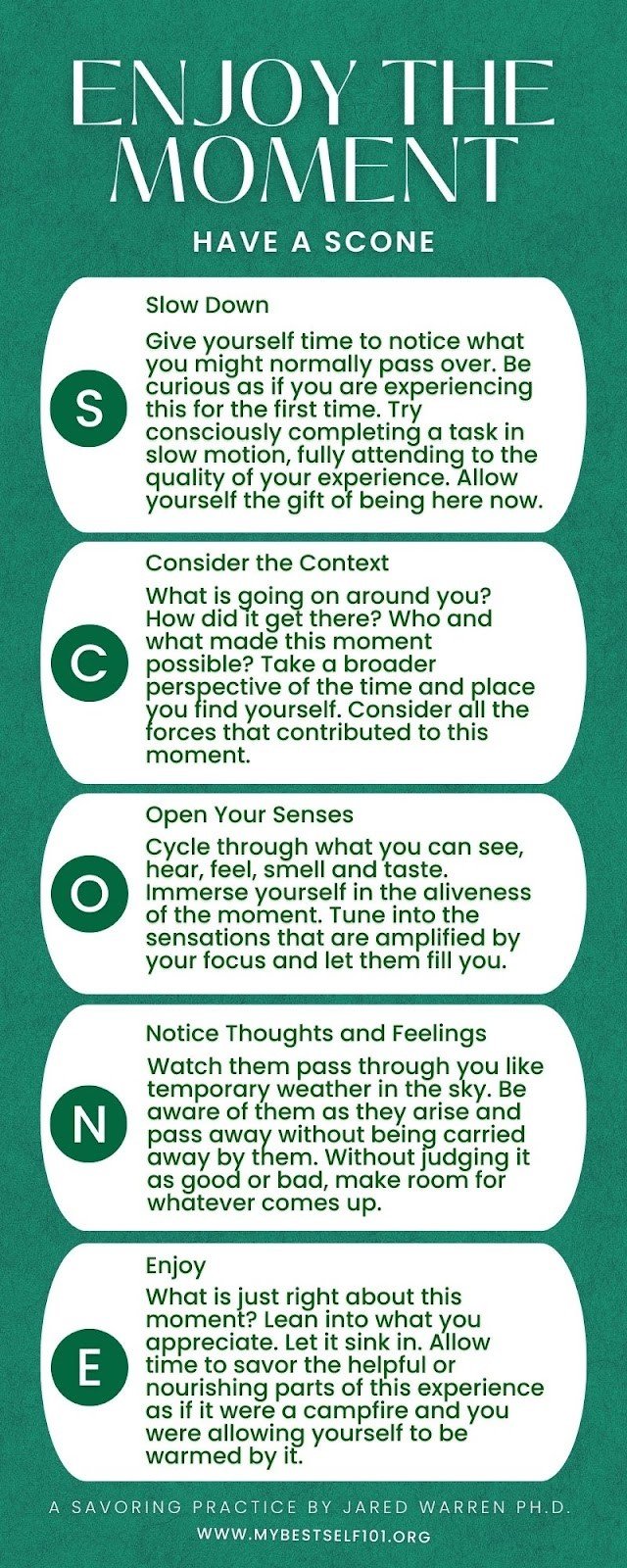
Pathways to being can be a formal meditation practice, pausing to be mindful throughout the day, praying, savoring, or practicing gratitude. Spending more time in being states strengthens connections with not only our true selves but with others. As a therapist, I often feel a greater connection with my clients when I simply be with them instead of trying to fix them. This looks like listening, not thinking of what I will say next, sometimes sitting in moments of silence together. One soul truly seeing and caring about the pain of another. Very often people need a non judgmental presence more than problem solving and answers. It’s when we are in a state of being that we can sense what others need. Finally, one of my favorite pathways to being is Dr. Warren’s SCONE practice (on the right) which is a reminder to slow down, drop into mindfulness, and savor the moment. May we be first, then do, and be well.
“It’s the being states that allow us to reconnect with what we most cherish” -Tara Brach
References
Böll, Heinrich (1995). "Anecdote Concerning the Lowering of Productivity". The Stories of Heinrich Boll. Leila Vennewitz (translator). Northwestern University Press. pp. 628–630

Flooded: Sink or Swim With Your Emotions
by Andrea Hunsaker
They called it a 500 year flood. Late in the Spring of 2020, on top of the COVID crisis, torrential rains and the failure of two dams sent a surge of cold, brown destruction into the city of Midland, Michigan. Ten thousand residents were forced to evacuate their homes, some in boats, as the flood swallowed cars, demolished bridges, and swept away entire houses. One of those residents was Barb. I met her in the aftermath after the waters had receded as she was slogging through her damaged family home picking up muddied framed pictures and clutching a stack of soggy albums. She wasn’t expecting us so she was deeply grateful when a group of volunteers showed up from neighboring cities to help with the cleanup. There was a waist high wet mark along the wall and everything under it had to be thrown out. Even the refrigerator was ruined, it had floated around the kitchen when the water was up to the silverware drawer and was now tipped over against the counter. I lost count of the truckloads we hauled away from the house. “It’s just stuff,” Barb told me, “...but it’s not just stuff.” Even after the house was empty of furniture, it wasn’t over. The once light colored, now brown carpet had to be taken up, and the wet drywall knocked out. When we were done, it was a skeleton of the place it was only days before.
Throughout the day I had watched Barb as she dealt with it all - the discovery of a drawer of her childrens’ drawings floating in latte colored water, the revelation that the walls had to be torn out, the appraiser breaking the news that the house was not worth restoring. She clearly felt each blow and was open about her experience, often telling us (complete strangers wearing COVID masks) about the meaning of certain lost possessions. She openly cried when she saw the handprints of her children in the concrete on the living room floor, exposed now after being hidden for years under the carpet. I could only imagine the flood of emotions she must have been experiencing then. Waves of sorrow and loss rising and breaking through the dams of social expectation to be emotionally tough. Much like the flood to this home; dismantling, unexpected, and unwelcome. What impressed me about Barb was that she still functioned through it. She made hard decisions about what needed to be done, was present with those around her, and expressed gratitude and joy. Not everyone can do that. Her husband came to drop off supplies, took a look at the destruction to his childhood home, and quite understandably, left. Difficult emotions have often been compared to water. Their weight has the potential to pull us down under an ocean of sadness, fear or anger. No wonder we try to resist, numb and escape. But as Barb knows, there are skillful ways to deal with them so they wash through us, allowing us to stay afloat.
Avoiding emotions actually makes them stronger. It’s like having a flooded house whose waters never recede, they float around in the basement growing toxic mold and infecting everything else. Research shows suppressed emotion has negative consequences on memory, blood pressure, aggression, anxiety, and depression. And there are consequences to our relationships. Have you ever found yourself thinking, “Why did I do that? I didn’t mean to be so sharp.” An overreaction is your body’s way of releasing pent up emotions that haven’t been properly dealt with.
All Emotions Have Value.
The first thing we do wrong is to label certain emotions as ‘negative’, or ‘bad’. In reality, all emotions have profound value. Author Joie Seldon explains that emotions are a physiological information system. They are the language of the physical body telling you about your relationship to whatever is going on outside you (to people, your circumstances) or to yourself internally. They are prompting you to action that is optimally beneficial to your survival and well-being. Seldon describes sadness, for example, as an inward moving energy, it slows us down and it’s message is to take action to process and honor what has been lost. Fear is a protective emotion who’s message is to ‘pay attention’ - either to something outward or to something on the inside. And anger is an outward moving energy. It is a boundary setting emotion who’s message is to ‘stand in your power’. So when the floods come, welcome them, and ask what message your body is trying to tell you.
This Is Temporary.
Another mistake we make is that in the heat of the moment we tend to focus only on our present emotional state and think it will last forever. During an argument with your partner, suddenly all past and future good times are forgotten, she has never done anything good for you, and essentially has ruined your life. You forget that 24 hours earlier you were happily playing tennis together and tomorrow you will have forgotten what the argument was even about. Author Sonja Lyubomirsky points to research that older individuals are happier than younger ones partly because they have learned through experience that difficult emotional states don’t last, and as a result they can weather them with optimism. They are able to be aware of what they are feeling without overly identifying with it. One practice that helps develop this skill is the leaves on a stream exercise found here: https://www.youtube.com/watch?v=r1C8hwj5LXw
Recognize, Allow, Investigate, Nurture.
The practice of RAIN is an excellent method to develop a good relationship with emotions. It involves 1) Being mindful of and naming the emotion, 2) Allowing it to be there just as it is, “This Belongs”, 3) Investigating with kindness, “What most wants attention?”, and 4) Nurturing with self compassion. You can try this practice with Tara Brach here: https://youtu.be/wm1t5FyK5Ek
Processing v. Ruminating.
Processing leads to acceptance and release, but if you are stuck in a negative loop of replaying past hurts, if the feeling has the same intensity without moving toward solutions or feelings of resolution, then this is rumination. Rumination doesn’t produce new ways of thinking, new behaviors or acceptance. If you find yourself stuck, you can move toward processing by asking yourself “What have I learned from this situation? In what ways have I grown? What is the message for me? What is my plan of action according to my values?”
And Be Kind to Yourself.
I think the key to dealing with emotions is learning self-compassion. Emotions aren’t weakness, they are human. And, as far as I know, everyone is human and has a need for kindness, especially from our worst inner critics. Dr. Jared Warren’s Self-Compassion course is a game changer and I highly recommend it: https://courses.mybestself101.com/p/self-compassion/?coupon_code=SC-HALF&product_id=1322651
After an emotional day of cleanup, I stood with Barb outside her gutted home on dry ground with the sunlight bouncing off the plaster in her hair. I felt assured that she would be okay. She was smiling and laughing with us, telling us of her gratitude for the support of friends and faith. The flood waters had receded from this house, and they would recede from her.
The Guest House
The Guest House
This being human is a guest house.
Every morning a new arrival.
A joy, a depression, a meanness,
some momentary awareness comes
as an unexpected visitor.
Welcome and entertain them all!
Even if they are a crowd of sorrows,
who violently sweep your house
empty of its furniture,
still, treat each guest honorably.
He may be clearing you out
for some new delight.
The dark thought, the shame, the malice.
meet them at the door laughing and invite them in.
Be grateful for whatever comes.
because each has been sent
as a guide from beyond.
— Jellaludin Rumi
https://www.youtube.com/watch?v=ZCsciFR5IAo
Get Over Yourself: Cultivating Self-Transcendence
Jan 31, 2023
by Andrea Hunsaker
— William James
If I could look into the black box of my head, I wonder what percentage of my thoughts are about me. “My hands are cold. I can’t think of anything good to write. Just write my thoughts. I have no thoughts. The thought train has left the station. Ooh that’s good, they’ll think I’m funny. It’s not that funny. Is there any fudge left?” Granted, it is necessary to think about yourself for survival reasons. The heart pumps blood to keep you alive, the brain pumps thoughts to keep you alive. (And to the brain, social situations are survival situations since separation from the tribe was a death sentence back in the day.) It’s exhausting - All these thoughts looking out for threats trying to protect ourselves. And at the base of it is some form of the question, “Am I good enough?” The self can be a major source of suffering.
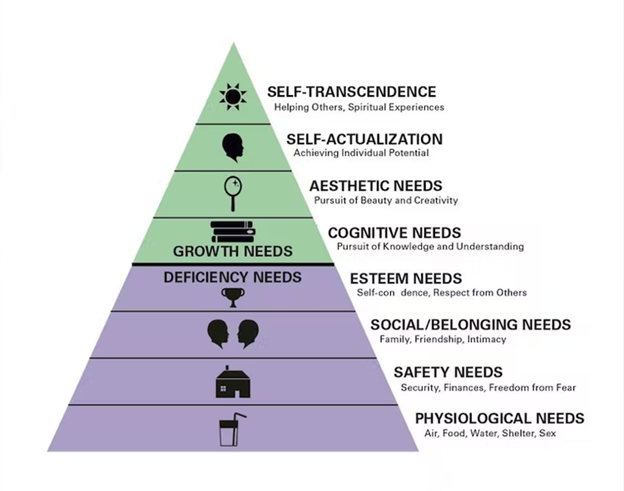
You may recall the hierarchy of needs you learned about in Psychology class. It depicts Abraham Maslow's theory of motivation—the things a human needs to live their best life. The picture in your book would look like a pyramid, with self-actualization (being all you can be) at the top, psychological needs in the middle (esteem, belonging), and basic needs at the bottom (security, safety, food, water, warmth), (and probably a previous student’s contribution at the base - WiFi - 100% accurate in my case).
But toward the end of his life, Maslow expanded his theory. He recognized the peak of human experience was more than achieving a person’s individual potential. Being our best self isn’t just about our self. He recognized through his research that people could, and do, rise above themselves and connect to something greater, and that humans need this connection to the whole in order to be whole. His revised theory looks like this with self-transcendence at the peak of human potential:
Self-transcendence is a merging between the self and the world around you; it is expanding the boundaries of yourself to include something greater (a cause, nature, humanity, or the universe). Let me give you a few examples of increasingly transcendent experiences:
But toward the end of his life, Maslow expanded his theory. He recognized the peak of human experience was more than achieving a person’s individual potential. Being our best self isn’t just about our self. He recognized through his research that people could, and do, rise above themselves and connect to something greater, and that humans need this connection to the whole in order to be whole. His revised theory looks like this with self-transcendence at the peak of human potential:
Self-transcendence is a merging between the self and the world around you; it is expanding the boundaries of yourself to include something greater (a cause, nature, humanity, or the universe). Let me give you a few examples of increasingly transcendent experiences:
An experience of love and connection:
I was out jogging along a dirt road when out of the corner of my eye I saw 3 little goats running toward me. I stopped and let them investigate my knees. I was honored that these beautiful creatures instantly trusted me and I felt a connection and a concern for their welfare. Their needs became mine. I didn’t want them to get lost or hit in the road, so I led them back to their nearby farm, rang the doorbell and chatted with the thankful owner as she returned them to their enclosure. For those minutes all the usual insecurities about myself were gone, all was right in the world. I had even forgotten about the triangular patch I wore between my eyes that day to keep me from squinting in the sun and deepening my frown lines, and when I remembered mid-conversation with the goat mom, it didn’t even phase me, and I didn’t even lie about my name or plan a new running route to never see her again. Now, I feel a warmth in my chest every time I run by my little goat buddies.
An experience of peace and awe:
A fresh six inches of snow had fallen overnight, and after shoveling the driveway, I went out and laid down in a clearing in our Michigan forested property. I remember a great silence and an overwhelming sense of peace and warmth as I looked at the sky and the sparkling snow covered landscape. I felt like I was a part of it all—the unspeakable beauty, mystery and majesty. The magnificent snow covered world that included me was just right as it was. It is hard to describe, but I have never forgotten that feeling of awe and belonging.
A fresh six inches of snow had fallen overnight, and after shoveling the driveway, I went out and laid down in a clearing in our Michigan forested property. I remember a great silence and an overwhelming sense of peace and warmth as I looked at the sky and the sparkling snow covered landscape. I felt like I was a part of it all—the unspeakable beauty, mystery and majesty. The magnificent snow covered world that included me was just right as it was. It is hard to describe, but I have never forgotten that feeling of awe and belonging.
Jared’s peak transcendent experience:
I was on one of my first astrophotography adventures, alone at about 2:00 am, overlooking Delicate Arch in Arches National Park (Utah). I was waiting for the moon to set so I could have the darkest sky possible to photograph the Milky Way. I sat there for at least a couple hours in the deep quiet, admiring the unique sandstone landscape and the brilliant expanse of stars. I still don’t know what made this happen, but as I continued to take in the scene, I started to feel myself being absorbed into it. Instead of a sense of looking out from a place inside my head, it was as if I had no head, no body. There wasn’t a “me” anymore. I was the whole landscape, the whole sky. There was a sense of extraordinary calm and satisfaction. Everything was perfect, and nothing could change that, not even death. -Jared Warren
Transcendent experiences (often called peak experiences) are surprisingly common. About ⅓ of the U.S. population reports they have had an experience where they have ‘felt at one with all things’ (Yaden, et al. 2017). The religious and non-religious alike, throughout time, across culture, age, gender, and socioeconomic status all report having peak experiences (Maslow, 1964). Though these unusual moments of awe, joy, serenity and wonder come as gifts, unplanned and uncontrolled, we can cultivate a way of being to be more receptive to them. Flow states, gratitude, savoring, mindfulness and meditation, spending time in nature, spiritual practices like prayer and pondering, intimate moments with family or friends, and aesthetic or artistic appreciation all foster states of transcendence where we can rise above the usual worries about the self and feel a part of something more. It turns out that the best life is when me becomes us.
Transcendent experiences (often called peak experiences) are surprisingly common. About ⅓ of the U.S. population reports they have had an experience where they have ‘felt at one with all things’ (Yaden, et al. 2017). The religious and non-religious alike, throughout time, across culture, age, gender, and socioeconomic status all report having peak experiences (Maslow, 1964). Though these unusual moments of awe, joy, serenity and wonder come as gifts, unplanned and uncontrolled, we can cultivate a way of being to be more receptive to them. Flow states, gratitude, savoring, mindfulness and meditation, spending time in nature, spiritual practices like prayer and pondering, intimate moments with family or friends, and aesthetic or artistic appreciation all foster states of transcendence where we can rise above the usual worries about the self and feel a part of something more. It turns out that the best life is when me becomes us.
If the subject of ‘getting over yourself’ interests you, try exploring the module on Transcendence on mybestself101.org. There you’ll learn more about what it is, why it’s worth pursuing, and find ideas to cultivate and allow it to enrich your life.
“At the deepest level, there is no giver, no gift, and no recipient…only the universe rearranging itself."— Jon-Kabat Zinn
References
Maslow, A. (1964). Religions, values, and peak-experiences. Columbus: Ohio State University Press.
“At the deepest level, there is no giver, no gift, and no recipient…only the universe rearranging itself."— Jon-Kabat Zinn
References
Maslow, A. (1964). Religions, values, and peak-experiences. Columbus: Ohio State University Press.
Yaden, D. B., Haidt, J., Hood, R. W., Jr., Vago, D. R., & Newberg, A. B. (2017). The varieties of self-transcendent experience. Review of General Psychology, 21(2), 143–160. https://doi.org/10.1037/gpr0000101.
Image retrieved from: https://en.wikipedia.org/wiki/Maslow%27s_hierarchy_of_needs
2. Image retrieved from: https://www.iands.design/architecture/article/10168474/look-to-maslows-hierarchy-to-see-design-and-architecture-impacts

Grow Your Funny Bone: The Human Strength of Humor
Jan 4, 2022
by Andrea Hunsaker“Humor was another of the soul’s weapons in the fight for self-preservation. It is well known that humor, more than anything else in the human make-up, can afford an aloofness and an ability to rise above any situation, even if only for a few seconds."— Viktor Frankl
It was a black night. Two dozen figures with narrow eyes directed at me crouched silently beyond the campfire eager to eat me alive. I was frozen, my heart thundering in my head drowning out logical thought. I knew they could smell my fear as they waited for my next move. I was at a retreat giving a presentation around a campfire to a group of teenage girls and had just asked a question. Silence. No, whatever sound contempt makes, that’s what I heard. That and the mocking of my self-critic in my head. But then I noticed something else - crickets. Loud actual crickets in the nearby forest. The situation struck me as funny, so I remarked, “Crickets!? Tough crowd,” with a dramatic tug on my collar. The girls chuckled, transformed from predators back to partially grown humans, and my brain rebooted, I skillfully reworded the question, and several girls volunteered thoughtful responses.
Humor is one of the original 24 human strengths proposed by Martin Seligman, the father of positive psychology. Barbara Fredrickson, another expert in the field, includes amusement as one of the top 10 positive emotions. Humor has the potential to help a person cope with stressful circumstances, see problems from a new perspective, create distance from difficult emotions, and connect us with others. Happily, you don’t necessarily have to be funny to benefit. The ability to produce humor is surprisingly unrelated to the ability to appreciate it (Moran et al., 2014), and you don’t have to be born with a sense of humor - this skill can be learned.
What makes us laugh? Among the theories, Peter McGraw has proposed the benign violation theory which means that something is funny if it is simultaneously “wrong yet okay, threatening yet safe, doesn't make sense yet makes sense,”(McGraw & Warner, 2014). It’s that place between boring and offensive where my grandfather noticed my sister’s bangs were in her eyes and offered to help her out by pulling out his pocket knife, both of them laughing as he tried to hold her still. The violation was benign until he shocked us all by actually cutting off a chunk, at which point my sister stopped laughing, which only made it funnier. Wrong yet okay.
Wielding the power of humor can be tricky. It’s one of those weapons that can be used for good or ill. Research indicates there are four types of humor; two that enhance well-being and two that are detrimental (Martin et al., 2003):
Adaptive Humor
One. Humor that connects - Using affiliative humor fosters relationships with others and reduces interpersonal tensions. This involves finding humor in everyday life occasions, being playful, and joking with others. Because quality relationships are so vital to a meaningful life, anything that strengthens these bonds is going to be a valuable tool. Affiliative humor might look something like this (pictured right)
Two. Humor for coping - Using self-enhancing humor in stressful life events enables a person to take a step back from the situation, see a broader perspective and get some emotional distance. The ability to laugh at yourself or your situation is about taking an optimistic view and looking for the funny side. If you were to take the Humor Styles Questionnaire (HSQ), a question to measure this style would be: “If I am feeling upset or unhappy I usually try to think of something funny about the situation to make myself feel better.”
Adaptive Humor
One. Humor that connects - Using affiliative humor fosters relationships with others and reduces interpersonal tensions. This involves finding humor in everyday life occasions, being playful, and joking with others. Because quality relationships are so vital to a meaningful life, anything that strengthens these bonds is going to be a valuable tool. Affiliative humor might look something like this (pictured right)
Two. Humor for coping - Using self-enhancing humor in stressful life events enables a person to take a step back from the situation, see a broader perspective and get some emotional distance. The ability to laugh at yourself or your situation is about taking an optimistic view and looking for the funny side. If you were to take the Humor Styles Questionnaire (HSQ), a question to measure this style would be: “If I am feeling upset or unhappy I usually try to think of something funny about the situation to make myself feel better.”
Both these humor styles are associated with greater well-being, resilience, optimism, gratitude and savoring.
Maladaptive Humor
Three. Humor that is overly self-deprecating - Using self-defeating humor is aggressive toward the self. There is a fuzzy line between not taking yourself so seriously and making yourself the butt of a joke at your own detriment. Some may put themselves down preemptively to avoid others insults, laughing to cover up the sting. Pay attention to how it affects you - If it makes you feel ‘less than,’ it’s maladaptive. HSQ questions include:
Maladaptive Humor
Three. Humor that is overly self-deprecating - Using self-defeating humor is aggressive toward the self. There is a fuzzy line between not taking yourself so seriously and making yourself the butt of a joke at your own detriment. Some may put themselves down preemptively to avoid others insults, laughing to cover up the sting. Pay attention to how it affects you - If it makes you feel ‘less than,’ it’s maladaptive. HSQ questions include:
- “If I am having problems or feeling unhappy, I often cover it up by joking around, so that even my closest friends don’t know how I really feel.”
- “When I am with friends or family, I often seem to be the one that other people make fun of or joke about.”
- “I often go overboard in putting myself down when I am making jokes or trying to be funny.”
Four. Humor that demeans others - Using aggressive humor denigrates others. It uses insults or put downs to get a laugh at another’s expense. Some types of sarcasm, teasing and making fun of others can be hurtful even if the target is laughing along. This does the opposite of connecting, so it’s not surprising this humor style is associated with greater hostility, lower levels of gratitude, and reduced relationship quality (Martin, 2019).
Growing Your Funny Bone
There are actually interventions that have been found effective to increase a person’s sense of humor (Ruch & McGhee, 2019). Just for laughs, I gave one a try and for a couple weeks each time I found myself in a stressful situation, I made an effort to think from a humorous perspective. Much like my meditation practice serves to take a seat in the nosebleed section and kindly observe my experience, this experiment lifted me out from under the shade of my serious umbrella and gave me space to see how bright life really is. With fun on my radar I feel lighter, more grateful, and in touch with a younger me. The other day I laughed so hard, I couldn’t stop. I can’t remember the last time I did that. Isn’t that the good life? Besides, as Robert Frost wrote, “If we couldn’t laugh we would all go insane.”
Growing Your Funny Bone
There are actually interventions that have been found effective to increase a person’s sense of humor (Ruch & McGhee, 2019). Just for laughs, I gave one a try and for a couple weeks each time I found myself in a stressful situation, I made an effort to think from a humorous perspective. Much like my meditation practice serves to take a seat in the nosebleed section and kindly observe my experience, this experiment lifted me out from under the shade of my serious umbrella and gave me space to see how bright life really is. With fun on my radar I feel lighter, more grateful, and in touch with a younger me. The other day I laughed so hard, I couldn’t stop. I can’t remember the last time I did that. Isn’t that the good life? Besides, as Robert Frost wrote, “If we couldn’t laugh we would all go insane.”
Here are some ideas from humor interventions you can try to keep a smile on your face:
- Watch T.V. sitcoms and relate the funny situations in the show to your own life.
- Make a list of commonly occurring problems you face and think of ways to have a lighter attitude when they come up.
- Make a list of things you are sensitive about in yourself and think of ways to hold them a little lighter and laugh at yourself.
- Keep a ‘3 funny things’ journal and at the end of each day write a list of 3 funny things that happened that day.
- After a stressful event, think of ways you could have handled it with humor.
“May you go laughing"— Turkish expression
References
Moran, J. M., Rain, M., Page-Gould, E., & Mar, R. A. (2014). Do I amuse you? Asymmetric predictors for humor appreciation and humor production. Journal of Research in Personality, 49, 8–13. https://doi.org/10.1016/j.jrp.2013.12.002
McGraw, P., & Warner, J. (2014). The humor code : a global search for what makes things funny / Peter McGraw, PhD and Joel Warner. Simon & Schuster.
Martin, R. A., Puhlik-Doris, P., Larsen, G., Gray, J., & Weir, K. (2003). Individual differences in uses of humor and their relation to psychological well-being: Development of the Humor Styles Questionnaire. Journal of Research in Personality, 37(1), 48-75. https://doi.org/10.1016/S0092-6566(02)00534-2
Martin, R. A. (2019). Humor. In M. W. Gallagher & S. J. Lopez (Eds.), Positive psychological assessment: A handbook of models and measures (pp. 305–316). American Psychological Association.
Ruch, W., & McGhee, P. E. (2014). Humor intervention programs. In A. C. Parks & S. M. Schueller (Eds.), The Wiley Blackwell handbook of positive psychological interventions (pp. 179–193). Wiley Blackwell. https://doi.org/10.1002/9781118315927.ch10

4 Ways to Instantly Improve Your Relationship
Feb 23, 2021
by Andrea HunsakerThe sun is sinking over the water, coloring the sky with a warm glow. A couple relaxes on the couch reading magazines and watching TV in a romantic Seattle vacation apartment overlooking the blue waters of the Montlake coast. No work, no kids, just the two love birds...oh, and the cameras mounted on the wall, the heart rate monitors strapped to their chests, and the one-way kitchen mirror that hides the room of researchers observing their every interaction. The next hit reality show? Not quite. This is the famous “love lab,” where researcher John Gottman invited hundreds of couples to stay the weekend so he could study them from 9 a.m. to 9 p.m. (minus bathroom breaks). He studied so many couples and with so much detail, in fact, that he can now observe a couple talking for 15 minutes and then predict with 91% accuracy whether or not they are headed for divorce. He doesn’t get invited to many dinner parties.
Considering what we know about the importance of supportive relationships to health and happiness, Gottman’s research on couple relationships is gold. We know, on average, that married people are more healthy both physically and mentally. In fact, a person’s romantic relationship affects their health just as much as diet and exercise (Robles et al., 2014). But these effects go both ways. A relationship in distress deteriorates health and well-being. So, Gottman’s extensive research on how happy relationships work and what happens between couples in troubled waters can be both a user's guide to nurturing your partnership and a caution for what not to do.
Beware the Four Horsemen
It can get pretty boring in the observation room behind the “love lab,” so Gottman asked his participants to get in a fight. He asked them to discuss an ongoing disagreement, and discovered that troubled relationships had certain things in common. Happy couples fight and argue and even have screaming matches, but there was a difference in the way they did it. The troubled relationships heading for divorce included some form of what Gottman calls the four horsemen of the apocalypse (signaling the end of days…get it?).
1. Criticism - This is more than just a complaint, which focuses on a specific behavior (e.g. “I wish you shoveled the driveway yesterday like you said you would”). Criticism is an attack on the partner’s character or personality (e.g. “You never follow through with your promises. I can’t count on you”).
Beware the Four Horsemen
It can get pretty boring in the observation room behind the “love lab,” so Gottman asked his participants to get in a fight. He asked them to discuss an ongoing disagreement, and discovered that troubled relationships had certain things in common. Happy couples fight and argue and even have screaming matches, but there was a difference in the way they did it. The troubled relationships heading for divorce included some form of what Gottman calls the four horsemen of the apocalypse (signaling the end of days…get it?).
1. Criticism - This is more than just a complaint, which focuses on a specific behavior (e.g. “I wish you shoveled the driveway yesterday like you said you would”). Criticism is an attack on the partner’s character or personality (e.g. “You never follow through with your promises. I can’t count on you”).
2. Contempt - This is criticism in hulk form—full of hostility or disgust. It often includes sarcasm, mocking, and name calling (e.g. “You’re such an idiot”). An eye roll is a tell-tale sign of contempt. It essentially gives the message, “I am better than you.”
3. Defensiveness - This is a refusal to take responsibility for a problem, and counter attacking or cross complaining. (“It’s not me, it’s you.”)
4. Stonewalling - This is when a partner shuts down from the conversation. They put up a wall and offer no evidence that they are affected by what the other is saying. (“Whatever, I don’t care.”)
“The crimes of the heart are usually misdemeanors.— Christensen, Doss & Jacobson (2014)
The Antidotes
If you recognize some of these in your romantic relationship, all is not lost. While Dr. Gottman was researching marriages, he met his wife, clinical psychologist Julie Schwartz Gottman. Together, they are the dream team of saving troubled marriages and making relationships go from “okay” to “great.” Combining research with clinical practice, they have discovered the antidotes for the four horsemen.
1. The antidote to criticism is to make requests about a specific behavior instead of attacking your partner's character. This can be done by avoiding the word “you” and using “I”-statements to talk about your feelings. Doing this will create a “gentle start-up”—the ability to address a problem gently without insulting your partner. Conversations that start this way are much more likely to go well because the receiving partner is more willing to listen and compromise.
“The crimes of the heart are usually misdemeanors.— Christensen, Doss & Jacobson (2014)
The Antidotes
If you recognize some of these in your romantic relationship, all is not lost. While Dr. Gottman was researching marriages, he met his wife, clinical psychologist Julie Schwartz Gottman. Together, they are the dream team of saving troubled marriages and making relationships go from “okay” to “great.” Combining research with clinical practice, they have discovered the antidotes for the four horsemen.
1. The antidote to criticism is to make requests about a specific behavior instead of attacking your partner's character. This can be done by avoiding the word “you” and using “I”-statements to talk about your feelings. Doing this will create a “gentle start-up”—the ability to address a problem gently without insulting your partner. Conversations that start this way are much more likely to go well because the receiving partner is more willing to listen and compromise.
2. The antidote to contempt is appreciation. Russ Harris, author of ACT with Love, suggests a person identify 3 things each day about their partner. Appreciating your partner’s strengths and qualities and recognizing even small things that your partner does for you instantly warms the relationship, and with repetition, strengthens the bonds between you:
“3 Things I Noticed Today That I Appreciate About My Partner”
“3 Ways My Partner Contributed to My Life Today”
“3 Things My Partner Said or Did Today That Represent Their Best Strengths and Qualities”
Find the worksheet here: http://eightfoldcounseling.com/wordpress/wp-content/uploads/13-Appreciating-Your-Partner.pdf
3. Accepting responsibility for the ways you contribute to the problem is the antidote for defensiveness. Try not to take it personally. Remember: the problem is the problem, not you or your spouse. Be open to seeing things from your partner’s perspective. Being willing to say “I'm sorry” goes a loooong way. And self-compassion helps here too. It also helps to see the longing in your partner’s complaint. The wife who is upset that her husband comes home late really just wants to spend more time with him.
3. Accepting responsibility for the ways you contribute to the problem is the antidote for defensiveness. Try not to take it personally. Remember: the problem is the problem, not you or your spouse. Be open to seeing things from your partner’s perspective. Being willing to say “I'm sorry” goes a loooong way. And self-compassion helps here too. It also helps to see the longing in your partner’s complaint. The wife who is upset that her husband comes home late really just wants to spend more time with him.
4. Self-soothing is the antidote for stonewalling. The Gottmans found that those who stonewalled were physiologically flooded. They had racing heart rates and were in a fight/flight state which made it impossible to think, let alone come to a peaceful understanding. Tell your partner that you need a break and that you would like to come back to the conversation in 20 minutes (that’s how long the Gottmans found it takes). During that time, ground yourself with something that soothes you, like meditating—the RAIN practice is an excellent choice—or reading a book. Then, come back to the conversation with some space from your thoughts and feelings.
There is no such thing as a perfect relationship, and it doesn’t have to be! A little nurturing and intentional attention to your significant other is an investment in health and happiness for the both of you. May you love and be loved on your life's journey with a good friend beside you. Find more resources to tend to your relationships here.
“As soon as I saw you, I knew a grand adventure was about to happen."— Winnie the Pooh
References
Christenses, A., Doss, B., & Jacobson, N. (2014). Reconcilable Differences. Guilford Press.Robles, T., Slatcher, R., Trombello, J., Mcginn, M. (2014). Marital quality and health: A meta-analytic review. Psychology Bulletin, 140, 140–87.
Christenses, A., Doss, B., & Jacobson, N. (2014). Reconcilable Differences. Guilford Press.Robles, T., Slatcher, R., Trombello, J., Mcginn, M. (2014). Marital quality and health: A meta-analytic review. Psychology Bulletin, 140, 140–87.

Meditation: There's a Puppy in my Brain
Dec 29, 2020
By Andrea HunsakerI’m attending class along with sixty other heads and shoulders in my living room with a laptop on my knees. One plus of this pandemic is that from 1,360 miles away, I can attend BYU’s version of the most popular courses in Harvard’s history: Positive Psychology. Or as I like to think of it, The Owner's Manual for Being Human. This is scientific, critical, basic survival information about how to live a happy and fulfilling life. I'm convinced that someday it will be taught alongside math and social studies in high school curriculums. Today, our professor is talking about meditation—a common practice in Eastern traditions, but still a fairly new concept to the Western side of the world. A slide pops up on my screen of an innocent-eyed puppy with a muddied nose and paws pressed up to a glass door. “Learning to meditate is like training a puppy,” the professor tells us. “Have patience with your mind.”
My eyes drift over to my own dog, Kody, not yet a year old, settled on top of the couch (where he’s not allowed to be). Along with approximately 100% of the rest of the country, we got a puppy this year. I thought our family of 4 kids and 2 bunnies was complete and I was perfectly happy without a dog. But after 2 decades of listening to their pleading, I finally gave in to my children and husband, and we chose a breed that promised to be perfect in every way, and was often trained as a therapy dog. Who couldn’t use a calming, accepting presence in their life?
Well, Kody must have been switched at birth with a badger because our therapy dog needs therapy. The poor thing is anxious. Kody started out in a puppy training class of 8 dogs. He barked so much the first day they gave him a special lavender calming collar. The second class, we were moved to a corner in the back of the room where he could only see a few dogs; still he barked and growled tirelessly at all his new and threatening classmates and their owners. By the third class, a couch was moved in front of us so he couldn’t see anyone at all and an extra trainer had the sole job of throwing bits of cheese from a safe distance to try to keep him quiet so the other frustrated participants could hear the instructions. Now, we don’t know why exactly, but class attendance started dwindling, and by the last two classes Kody and I were the only participants.
So when Dr. Warren connects learning to meditate to puppy training, this is what I think of. It’s the difficult practice of not reacting to the stream of thoughts, feelings, and experiences that constantly compete for our awareness. It is the maturity of sitting, observing, and recognizing that not everything is as threatening as it seems. Like my mind, Kody wanders. He chases cars and skateboarders and small children, trying to rid the earth of the threats of squirrels and blowing leaves. But we gently pull him back on his leash—“It’s okay, you don’t need to chase that, sit, stay, look at me, focus, be calm, you are getting worked up when you don’t have to.”
Wandering and getting distracted are natural things minds do to see things as threats. It’s almost like we all have an anxious puppy in our heads. Our primitive fight-or-flight responses kick in before the newer prefrontal cortex has a chance to weigh in. The result is that it takes some time to know how you really want to react. According to your puppy brain? Or according to your values?
So when Dr. Warren connects learning to meditate to puppy training, this is what I think of. It’s the difficult practice of not reacting to the stream of thoughts, feelings, and experiences that constantly compete for our awareness. It is the maturity of sitting, observing, and recognizing that not everything is as threatening as it seems. Like my mind, Kody wanders. He chases cars and skateboarders and small children, trying to rid the earth of the threats of squirrels and blowing leaves. But we gently pull him back on his leash—“It’s okay, you don’t need to chase that, sit, stay, look at me, focus, be calm, you are getting worked up when you don’t have to.”
Wandering and getting distracted are natural things minds do to see things as threats. It’s almost like we all have an anxious puppy in our heads. Our primitive fight-or-flight responses kick in before the newer prefrontal cortex has a chance to weigh in. The result is that it takes some time to know how you really want to react. According to your puppy brain? Or according to your values?
And that’s what meditation does for you. It trains your brain to observe without reacting until the puppy has calmed down, everything is processed and you can now act from your values instead of Kody running the show. Imagine what different choices you would make if you were less reactive. Personally, I would eat differently, have better relationships, and generally live from a place of greater ease, to name a few. The Dalai Lama once said, “If every 8 year old in the world is taught meditation, we will eliminate violence from the world within one generation.”
Meditating is simple, but it’s not easy. Luckily, there are lots of resources to help you. The apps Insight Timer and Headspace are great, and you can find mindfulness resources on My Best Self 101’s Mindfulness Module. And you may already be participating in a form of contemplative meditation without realizing it! One poll found that 7 out of 10 Americans pray every day. Prayer can be a sort of meditation because you’re taking the time to slow down and focus your awareness. Personally, I benefit from taking a step beyond a “laundry list of requests” and instead spending time simply being in the presence of the divine, accepting what is, and viewing life from a higher perspective. Mother Teresa was once interviewed by Dan Rather. He asked her, “When you pray, what do you say to God?” She replied, “I don’t say anything. I listen.” So then he asked, “When God speaks to you, then, what does he say?” She told him, “He doesn’t say anything. He listens.” Rather didn’t know what to say to this, so Mother Teresa added, “And if you don’t understand that, I can’t explain it to you.”
I’ll give you an embarrassing glimpse of what goes on in my mind. (John Edmunds says, “Don’t walk a mile in my shoes, that would be boring. Spend 30 seconds in my head, that’ll really freak you out.”) So, I’m standing in line behind a slow patron writing a check at the grocery store. The belt is empty but moving. I wait for a bit behind my cart, and then step in front of it to start loading my groceries at the end of the belt. The cashier is alarmed and asks me to step back and keep 6 feet from the person in front of me. Here my brain goes full puppy; I feel unfairly attacked and I have a fierce urge to jump up on the conveyor belt with the eggs, glide toward him, AND...well, let’s not kid ourselves. I’m more of a flighter than a fighter, so the fantasy stops here. But, instead, I’ve been meditating, so I feel my irritation rise, and watch the thoughts in my head, “What!? I’m not doing anything wrong!” Then watch as the anger turns to shame: “Someone doesn’t approve of me. I’m not good enough.” Here my prefrontal cortex starts catching up: “It’s okay. This isn’t a survival situation. Everyone feels rejected sometimes. You are a conscientious person. It stings, but it’s temporary. He’s just trying to be a good person, too. I breathe, feel my heartbeat, the heat in my face, feel the waves wash over me, and feel them start to dissipate. This is what it’s like to be human. By the time I’m in front of the cashier, I have distance enough from my own thoughts to notice he is older, tired. I notice he hesitantly greets me, takes a cautious look at me. Because I’ve been meditating, I’m not shooting laser beams at him from my eyes. He asks about my choice of strawberry lemon ice cream. I sincerely engage in conversation. I don’t bark at him.
Back on my living room couch, Kody has moved to my lap as the professor lists the research-supported evidence of meditation’s benefits; greater happiness and less anxiety and depression, a stronger immune response, higher intelligence, and improved creativity and cognitive flexibility. In other words, training a mind is worth it. It takes effort. It takes constant correction and patience. And it doesn’t work to get frustrated at yourself. Puppies and minds don’t respond well to negativity. And you can’t stay mad at that face anyway. Kody ate 6 pairs of my flip flops...If anyone else did that, they would definitely not be invited back; but, well, he’s so dang cute and loyal.
Back on my living room couch, Kody has moved to my lap as the professor lists the research-supported evidence of meditation’s benefits; greater happiness and less anxiety and depression, a stronger immune response, higher intelligence, and improved creativity and cognitive flexibility. In other words, training a mind is worth it. It takes effort. It takes constant correction and patience. And it doesn’t work to get frustrated at yourself. Puppies and minds don’t respond well to negativity. And you can’t stay mad at that face anyway. Kody ate 6 pairs of my flip flops...If anyone else did that, they would definitely not be invited back; but, well, he’s so dang cute and loyal.
Dogs and minds need training for their own good. All those puppy classes for Kody—they were really a means to save him from himself. Otherwise he would suffer a painful death by...I don't know, hypothetical situation, okay actual situation...trying to jump out of a moving jeep at 40 mph to chase a pedestrian, but being pulled back in the nick of time. Training is for the dog's well-being. Disciplining some natural tendencies makes a happier dog and happier everyone else around him. So, I would venture to say that those who enjoy meditation the least are those who need it the most. The anxious, busy, impatient mind doesn’t want to stay still, but you can train it to. You are just like an untrained puppy, and that’s okay.
But I won’t tell you that you should meditate. If you’re like me, you might be overloaded with advice about how to live. I’m guessing your list of ‘things I know are good for me that I’m not doing as much as I would like’ is as long as mine. But I’ll plant a seed. And one day, when that puppy in your head has gotten you into enough trouble, you’ll know where to turn. Because when the student is ready, the teacher appears. I’ll just tell you that the effort of training your mind to watch and wait is worth it. Life is better here in the prefrontal cortex. And please, until you do—and I say this with the deepest of respect—try not to eat my flip-flops.

Comparison: Use the Self Compassion of E.N.V.Y.
Aug 20, 2019
by Andrea Hunsaker“Comparison is the thief of joy” Theodore Roosevelt once quipped. So, there you have it - just don’t compare? Great advice… except that it’s impossible. The advice to simply stop comparing yourself to others is about as helpful as telling your lungs to stop breathing. The human brain must make comparisons to make sense of the world and assess our survival standing. It’s automatic and you can’t just stop. But there is a way to relate to the comparisons your brain makes that doesn’t leave you feeling inadequate all the time. [drum roll] Self-compassion.
I recently sat and watched the Broadway show Hamilton, and amidst the wonder and delight of the musical journey was a twinge. You see, I have a nice voice, and at one time I dreamed that I might also have made those sounds with my pipes. So, instead of completely enjoying the magnificent show, mixed in the experience was also a little prick of hidden hopes and deflated dreams.
I may just be a competitive person, but it happens more than I like to admit, and I think--I hope--it’s not just me. I’ll be listening to a podcast. Someone who can spin a sentence with eloquence and make the words reflect exactly their thoughts. A talent I wish I had. So, I’ll feel a little green. I don’t exactly wish misfortune on the smooth talking voice, but there’s the twinge. Like a tireless, overachieving intern with a clipboard, my brain eagerly points out what I don’t have as I go about my day; everywhere are tanned legs, wrinkle free foreheads, and eyebrows that don’t have to be drawn on.
So, in these moments, I’ve started to send myself compassion. I acknowledge that it hurts to feel the pain of something not achieved, a piece of fruit not reached, the heaviness of “I’m not enough”. This is hard. This is suffering. I watch the wave. Honor it. I recognize that this is a part of the human experience. Everyone feels this way about some things. This is not just my suffering, this is our suffering. May I give myself the compassion in this moment that I need. As I have fostered the habit of self-compassion, these little (and sometimes big) twinges have less effect on me. I can more quickly rebound, dismiss unhelpful comparisons and feel grounded by a love and appreciation for myself. When your brain is making unhelpful comparisons, think ENVY:
- E - Evolution of self. You are evolving, growing every day. Compare yourself today with yourself yesterday. Psychologist Sonja Lyubormirsky, notes that "people who are happy use themselves for internal evaluation. It's not that they don't notice upward comparisons, but they stay focused on their own improvement. A happy runner compares himself to his last run, not to others who are faster." When your brain is comparing you to others, send yourself compassion and then make the conscious effort to “Compare Me to Me”. Find satisfaction in your own evolution.
- N - Nurture. How does their talent nurture you? Recognize how you benefit from others’ good qualities and cultivate a joy for their success. See how you are connected with this person. See how their success helps to build and elevate you. Mudita is the Sanskrit word for sympathetic or vicarious joy. It is likened to the pure joy a parent might have for a child's happiness. Self-compassionate people are better able to experience Mudita because they see that all humans not only share suffering, but also joy. Connecting to the common suffering of humanity also connects us to the common joy. The simple fact that you can see the good in another person also means there is at least some of it in you too. Think Namaste, “The light in me sees the light in you.”
- V - Validity Check. Like a funhouse mirror, the eyes of envy are distorted. Check the validity of your thoughts about this comparison. Look at the bigger picture of yourself and others, the whole truth. See the whole person. We often callously compare others’ strengths to our weaknesses. Self-compassion recognizes your strengths in other areas. Ask the question, “What is the Whole Truth?”
- Y - Yet. You are not there YET. Foster a growth mindset. Recognize that abilities and intellect are not fixed. Self-compassionate people are more willing to try and less afraid of failure because they can count on themselves for the support they need to recover from setbacks. With effort and training, you can grow in yourself the talents you admire in others. See the journey that it took for this person to get where they are. If you get the chance you might ask them how they got there. Practice, Fail, Learn, Repeat. Tell yourself, “I’m not there... YET.”
Building self-compassion takes practice and effort and reading this article is a great first step. The free Self-Compassion module on mybestself101.org is a great next step, and taking the self-compassion course on that site will give you a 30-day roadmap for transforming self-criticism into self-compassion.